Historic Park Street in St. Petersburg: A Weekend Story
August 13, 2026
August 13, 2026
Most people who launch a kayak at the boat ramp where Park Street dead-ends into Elbow Lane North have made the same drive a hundred times without ever asking what sits just past the gravel lot. It looks like any other quiet corner of west St. Petersburg, a public park, a boat launch, palms leaning out over Boca Ciega Bay.
It is also one of the best-preserved Native American sites in Tampa Bay, and for the length of a guided walk, you can stand on top of it.
The public boat ramp at Park Street and Elbow Lane North is managed by the City of St. Petersburg Parks and Recreation, and it's the same stretch of shoreline residents already treat as their own quiet put-in for a paddleboard or kayak. A short walk down the same gravel drive, at 1700 Park St N, is a second entrance: take Park Street to the Jungle Prada building, at the corner of Park Street N. and Elbow Lane N., past the JP Tavern, heading toward Boca Ciega Bay. That's the entrance to a private historian-led walking tour of one of the oldest documented sites in the region, and as of this year it's still running, with fresh reviews posted through the summer.
The Jungle Prada Site, also known as the Anderson-Narváez Site, is an archaeological site featuring Indigenous Tocobaga mounds and the location of the historical Narváez expedition landing. The Tocobaga people inhabited the site for approximately 600 years, from 1000 to 1600 CE. Their settlement wasn't a single mound. It once contained a series of mounds stretching up and down Boca Ciega Bay for more than three miles, though most were dismantled and used as fill for 20th century urban development. What's left at the end of Park Street is one of the few pieces that survived the bulldozer, which is why it earned federal recognition: the site was added, on February 4, 2003, to the National Register of Historic Places.
Long before the bungalows went up, this stretch of shoreline saw one of the stranger footnotes in Florida history. In 1528, Spanish conquistador Pánfilo de Narváez landed here, beginning an ill-fated expedition across much of what is now the United States. Narváez didn't survive it. But four survivors, led by Álvar Núñez Cabeza de Vaca, completed an extraordinary eight-year journey from St. Petersburg all the way to the Pacific Ocean. It's the kind of story that would anchor a museum wing in most cities. Here, it's the historical marker at the end of a residential lane.
A rough timeline of what's stacked on this one corner:
The public park holds part of the story. The rest sits on private land that one family has looked after for generations. The property has been family-owned since the 1940s and features a botanical garden full of native plants used by the Tocobaga, sweeping views of Boca Ciega Bay, and one of the best-preserved Indigenous mounds in Tampa Bay. Visitors this year describe a guide named David, who by his own account is the owner and tour guide, the third generation of his family on this property with a history that goes back a thousand years. The walk runs about 75 minutes and includes a small museum with archaeological artifacts, plus the free-roaming peacocks that have made the property their own.
What makes this worth knowing, rather than just a fun historical footnote, is how tightly the past and the present overlap on this specific piece of ground. Portions of the Tocobaga mounds, along with picnic tables, a fishing pier, and a boat launch, sit inside the city park and are maintained by the City of St. Petersburg, while the better-preserved mounds next door remain private and accessible only by guided tour. You can put a kayak in the water and stand on a thousand-year-old village site in the same afternoon, without leaving the same block.
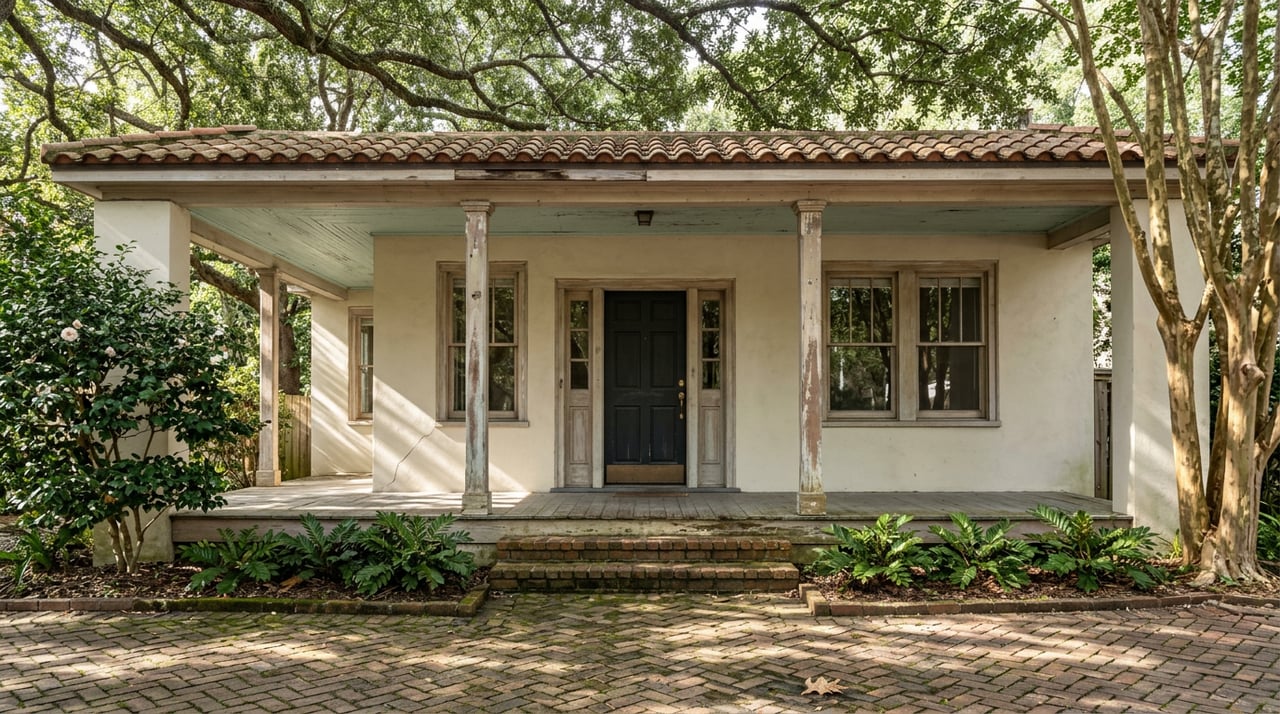
The Park Street corridor does this kind of double duty more than once. A few blocks east, Sunset Park sits at Park Street and Central Avenue in St. Petersburg, 33710, the same zip code that wraps the brick streets of Historic Park Street. It's not a coincidence that a listing for a 1920s home in the neighborhood describes the property as adjacent to the beautiful Sunset Park. Between the two ends of Park Street, a resident has a Native American archaeological site on one side and a bayfront park on the other, with the neighborhood's own brick streets and mature trees running the length between them. The Pinellas Trail, which residents already treat as one of the neighborhood's most loved features, ties the whole stretch together for anyone on a bike.
It's easy to describe Historic Park Street by its architecture alone, the bungalows, the brick paving, the oak canopy. That's accurate, but it undersells what's actually here. Most of the Tocobaga's three miles of shoreline mounds are gone, paved over decades before anyone thought to protect them. The piece that survived happens to sit exactly where the neighborhood's namesake street meets the bay, which means the oldest documented residents of this stretch of St. Petersburg never really left. They're still the reason there's a fence line worth walking up to.
If you're curious what else sits quietly along these blocks, or you just want to talk about the neighborhood you already know from a different angle, W Real Estate Group is always glad to compare notes.
Stay up to date on the latest real estate trends.
Embark on your next real estate journey with W Real Estate Group. Contact us today and let us turn your real estate dreams into reality. With W Real Estate Group, your success is our priority. Welcome home to a future of exceptional real estate experiences!