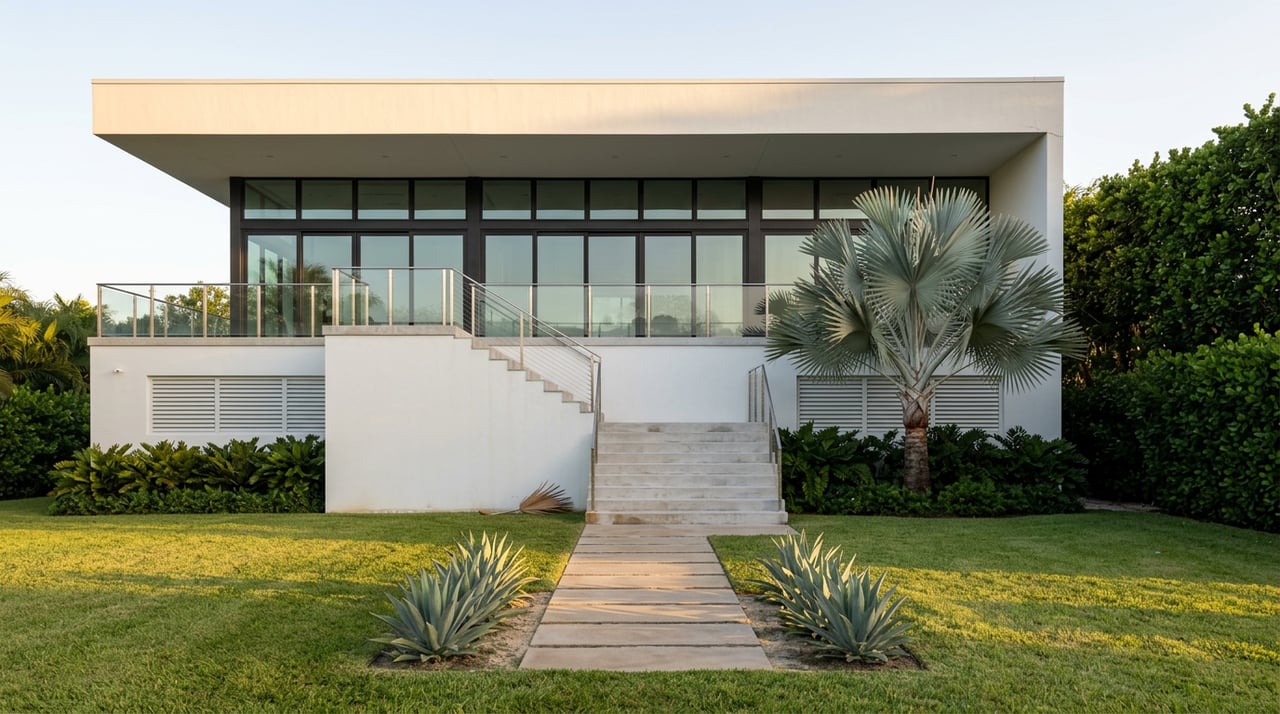
What Snell Isle's Median Price Is Actually Measuring
September 17, 2026
September 17, 2026
In January 2026, the reported median sale price on Snell Isle jumped 64.6 percent year over year to $1.5 million, based on 23 closed sales that month. Around the same stretch of this year, a separate trailing twelve month read put the median at $1,099,000, down 20 percent from the prior year. Both numbers describe the same 1,100 or so single family homes on the same peninsula, in the same market, in the same year.
That is not a typo and it is not two competing data providers disagreeing about arithmetic. It is what happens when a median gets calculated from a pool small enough that a single luxury closing can move the whole number. And on Snell Isle, that volatility is not random noise. It is the market's way of telling you something specific about how homes here actually get bought and sold, which the sticker price alone will not show you.
Twenty three sales is not a lot of data to build a market statistic on. When one of those sales is a multi million dollar estate and another is a modest interior lot, the median can swing by hundreds of thousands of dollars depending on which closings happened to land in that particular window. A separate March 2026 read placed Snell Isle's median in a steadier $1.3 million to $1.5 million band, which is probably closer to the underlying trend than either of the more extreme numbers, but even that range spans $200,000.
Part of the reason the spread is so wide comes down to what is actually changing hands. Entry level, non waterfront homes on Snell Isle have been listed in the $700,000 to $800,000 range, while premium waterfront estates and new construction routinely list above $3 million to $5 million. Averaging across that spread with a small sample size produces a number that technically describes the neighborhood but does not describe any specific home in it.
But there is a second, less obvious force widening that spread, and it has nothing to do with sample size. It has to do with what triggers a full teardown instead of a renovation, and that mechanism is quietly reclassifying a growing share of Snell Isle's home sales into land sales wearing a house price label.
Most of Snell Isle sits inside FEMA's AE or VE flood zones. Under federal floodplain rules, any renovation or repair to a structure in one of those zones that costs 50 percent or more of the structure's pre-improvement value triggers a requirement to bring the entire building up to current flood code, including elevating the lowest floor to base flood elevation. St. Petersburg applies a slightly tighter local version of that threshold, at 49 percent, and the city tracks renovation spend cumulatively over a rolling 12 month window rather than project by project.
The dollar math is not abstract. A structure valued at $1.5 million carries roughly a $735,000 renovation ceiling before the whole home has to be brought up to today's elevation and wind load code. Cross that line on a comparably sized flood zone home nearby and a remodel that started in the $180,000 range can balloon toward $600,000 to $900,000 once elevation, compliant utilities, and flood damage resistant materials get added to the scope. One local contractor who has run flood zone projects across Shore Acres, Snell Isle, and Venetian Isles put it plainly: a structural lift alone typically runs $150,000 to $250,000, before the house gets put back together, and full elevation scope rebuilds on a 2,000 to 3,000 square foot home commonly land between $600,000 and $1.2 million.
That same contractor made a point of warning against contractors who treat every project near the line as an automatic teardown. The threshold is a real constraint, not an excuse, and a builder who tracks cost to date closely enough can sometimes keep a renovation under 49 percent through scope discipline alone. But on a peninsula where much of the housing stock dates to the 1950s, 60s, and 70s and sits below current elevation requirements to begin with, that discipline gets harder to maintain the more ambitious the renovation gets.
Walk through active Snell Isle listings and a specific phrase keeps appearing: properties marketed with the flexibility to renovate or build new. That language is not just flexible marketing copy. On a corner lot near Coffee Pot Bayou or Smacks Bayou, it usually signals that the existing structure sits close enough to the 49 percent line, or far enough below current flood elevation, that a buyer's realistic path runs through demolition rather than restoration.
That is a big part of why builders who work this market describe Snell Isle as one of the most active teardown-rebuild markets on Florida's west coast right now. Vacant lots along Snell Isle Boulevard have been trading close to seven figures before a single board gets laid, which only makes sense if buyers are pricing the land and the view, not the aging structure sitting on it. When enough of a neighborhood's transactions are effectively land sales, the "home price" median stops measuring home value and starts measuring lot value with a permit attached, and that shift alone can explain a meaningful share of the spread between the different median reads circulating this year.
The clearest illustration of where this can land sits at 416 Brightwaters Blvd NE, a century old Mediterranean estate that hit the market earlier this year at $12.5 million after what the Tampa Bay Times reported was a four year rebuild. The roughly 6,065 square foot home, marketed as "Brightleaf," kept its 1920s architectural bones while overhauling mechanical, electrical, and plumbing systems, adding impact rated windows, and building out a resort style pool on a lot just under 28,000 square feet. Local brokers were watching the listing closely as a read on how far the top of St. Petersburg's market would stretch this year.
That single transaction, when it closes, could move a monthly median by itself. It is also a useful case study in what a compliant, code current renovation actually costs on Snell Isle when it is done at the top of the market rather than the middle. Four years and a full systems overhaul is what "renovation" can mean once a structure crosses into substantial improvement territory on a lot this size.
Roughly a third of Snell Isle's homes sit on waterfront lots, and most of those carry a private seawall that the homeowner, not the city, is responsible for maintaining. The scale of that liability is easier to see from the city's own seawall work. In 2024, St. Petersburg approved a $1.6 million contract to replace structurally deficient seawalls at three flood prone sites around the peninsula, one of them the 31st Avenue Northeast bridge on Snell Isle, according to St. Pete Catalyst's reporting at the time. That was public infrastructure spending for a single stretch of city owned wall, out of roughly 15 miles the city maintains directly.
Private seawall replacement runs a similarly wide range, commonly $300 to $800 per linear foot for standard concrete or vinyl construction, with some Gulf Coast projects running higher. A 60 foot residential seawall can land anywhere from $18,000 to $72,000 before permitting and engineering, and that is before accounting for a failing wall that needs full replacement rather than repair. Combined with the fact that roughly 98 percent of Snell Isle properties carry some degree of flood exposure, a seawall inspection belongs on the same due diligence list as the elevation certificate, not as an afterthought once the offer is already in.
Does the 49 percent rule apply to every home on Snell Isle? It applies to any structure in a FEMA designated flood zone, which covers the large majority of Snell Isle given how much of the peninsula sits in AE or VE zones. A small number of interior, non waterfront lots may fall outside those zones and would not be subject to the same threshold.
Is there a way to confirm a property's exact threshold before making an offer? The county's automated valuation letter is a starting point but is known to run 20 to 40 percent below a defensible market number, so for anything close to the line, a licensed Florida appraisal is the more reliable path before finalizing a renovation budget.
How long does a full rebuild actually take here? Custom estate builds on Snell Isle generally run 22 to 30 months from signed design agreement to certificate of occupancy, with waterfront sites that involve new seawalls, docks, or significant elevation changes sitting at the longer end of that range.
If you are weighing a Snell Isle property and trying to figure out whether the number on the listing reflects a home you can renovate or land you would be buying to rebuild, that is exactly the kind of question worth working through before you write an offer. W Real Estate Group works this market block by block and can help you read a specific address against the numbers that actually apply to it.
Stay up to date on the latest real estate trends.
Embark on your next real estate journey with W Real Estate Group. Contact us today and let us turn your real estate dreams into reality. With W Real Estate Group, your success is our priority. Welcome home to a future of exceptional real estate experiences!